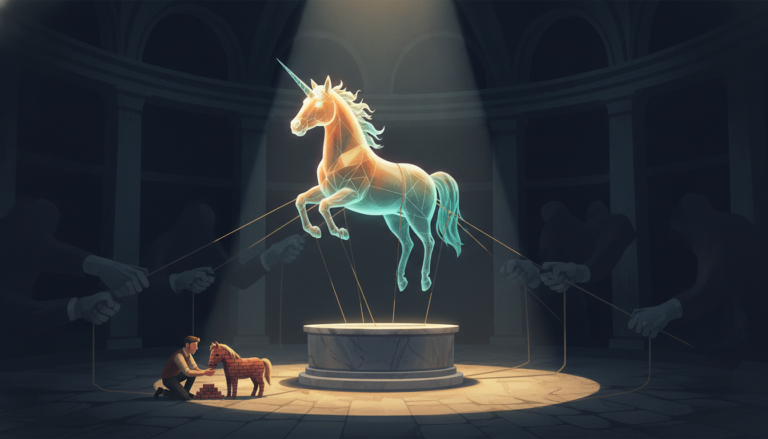

Richard Socher spent a decade becoming one of the most respected AI scientists on the planet. He ran AI research at Salesforce. He built You.com into a $1.5 billion company. He could have retired, consulted, joined a board, done the victory lap.
Instead, he just raised $650 million to build the thing that makes people like him unnecessary.
That’s the pitch behind Recursive Superintelligence, a startup that emerged from stealth last week with a team of 25 researchers, a $4.65 billion valuation, and a thesis so simple it’s almost uncomfortable: AI should build better AI. Not humans. Not PhD programs. Not billion-dollar research labs staffed with 400 people arguing over hyperparameters. The machine itself.
And honestly? If you’re a founder building anything that touches AI right now, this is the most important funding round you probably ignored.
The Team That’s Betting Against Themselves
Here’s what makes this different from every other “we’re building AGI” announcement you’ve scrolled past this year.
Look at who showed up. Tim Rocktäschel, who led the open-endedness and self-improvement teams at Google DeepMind. Josh Tobin, who was one of the first engineers at OpenAI and ran their Codex teams. Yuandong Tian from Meta’s FAIR lab. Alexey Dosovitskiy, the co-author of the Vision Transformer paper that changed how every model sees images. Tim Shi, who built Cresta into a unicorn. And Peter Norvig — the guy who literally wrote the textbook on artificial intelligence — is advising.
These aren’t people chasing hype. These are the people who created the hype. And they just collectively decided that the fastest path forward is to automate their own jobs.
GV and Greycroft led the round. Nvidia and AMD both put money in. When both GPU makers invest in a company whose explicit goal is to reduce how much human labor goes into AI research, that tells you something about where the industry thinks the bottleneck actually is. It’s not compute anymore. It’s the researchers themselves.
What “Recursive Self-Improvement” Actually Means (and Why Most People Get It Wrong)
Socher drew a sharp distinction in his TechCrunch interview that most coverage missed. Using AI to improve something — a letter, a piece of code, a marketing campaign — is just improvement. That’s what ChatGPT does. That’s what Cursor does. That’s table stakes.
Recursive self-improvement is different. It means the AI identifies its own weaknesses, designs experiments to fix them, runs those experiments, validates the results, and then uses the improved version of itself to find the next set of weaknesses. It’s a loop with no human in it.
Rocktäschel framed it through the lens of biological evolution. Animals adapt to their environment. Other animals counter-adapt. Eyes developed not because someone designed them but because the process kept running. Recursive is betting that the same dynamic works for intelligence itself, just faster.
Their first milestone? A system with the capabilities of “50,000 doctors” — not in medicine, but in AI research. A machine that can generate hypotheses about how to make itself smarter, test them in simulation, and implement the winners. Level 1 is autonomous training. Level 2 is autonomous architecture design. Level 3 is… well, Socher said products will arrive in quarters, not years.
Why This Matters More Than Another Billion-Dollar Round
If you’re a founder reading this and thinking “cool science project, not relevant to me,” let me explain why you’re wrong.
Right now, the AI industry operates on an assumption so fundamental that nobody questions it: building a good AI model requires expensive humans. The average AI researcher at a top lab makes $500,000 to $1 million a year. The top ones make more. Anthropic, OpenAI, Google DeepMind — they’re in a bidding war for maybe 2,000 people on the planet who can push the frontier forward. That scarcity is what drives the insane cost structures we’ve been covering — the $725 billion capex race isn’t just about GPUs, it’s about the humans who know what to do with them.
Recursive’s bet is that this bottleneck is temporary. That within a few years, AI research will be primarily conducted by AI systems. And if they’re right — or even half-right — the implications cascade everywhere.
First, model quality stops being a moat. If any company can spin up an AI research agent and have it improve their model overnight, the model layer commoditizes completely. We’ve already seen early signals of this: OpenAI recently disclosed that GPT-5.5 independently discovered a more efficient parallelization method that boosted its own inference speed by 20%. The machine is already starting to optimize the machine.
Second, the talent war ends. Not gradually, suddenly. If Recursive’s thesis works, you don’t need to hire the $800K researcher from DeepMind. You need to define the right problem and point the system at it. The skill shifts from “can you train a transformer?” to “can you articulate what intelligence needs to do differently?”
Third — and this is the one most founders miss — distribution and problem selection become the only durable advantages. When 130 AI agent companies are fighting over the same foundation models, the differentiator was always going to be something other than the model. Recursive just accelerated the timeline.
The Uncomfortable Question Nobody’s Asking
Recursive isn’t alone. Ineffable Intelligence raised $1.1 billion at a $5.1 billion valuation with a similar thesis. Google uses neural networks to design its own TPU chips. Anthropic and OpenAI both have internal teams working on automated AI research.
So here’s the question that should keep you up at night if you’re building an AI startup: what happens when the thing you’re building on top of starts improving itself faster than you can ship features?
Because that’s the real founder lesson here. It’s not about Recursive Superintelligence specifically. It’s about the trajectory. Every major lab is moving toward automated research. The question isn’t whether AI will eventually build better AI. The question is whether your startup’s value proposition survives that transition.
The answer, honestly, depends on where you sit in the stack. If you’re a model company competing on benchmark performance — you should be nervous. If you’re an application company solving a specific, painful, human problem and using AI as infrastructure — you’re probably fine. Maybe better than fine. Because when the model layer commoditizes, application-layer companies get cheaper inputs and keep their distribution moat.
It’s the same pattern we’ve seen before. Nobody remembers who made the best database engine in 2005. Everyone remembers who built the best products on top of databases. Socher isn’t building a database. He’s trying to make the database build itself. But as we saw with Cerebras handing 10% of itself to OpenAI, the infrastructure layer has a habit of getting captured by its biggest customers.
The winners in a world of recursive AI improvement aren’t the people who build the recursion engine. They’re the people who know what to point it at.
What You Should Actually Do About This
If you’re an early-stage founder, three things:
Stop building moats around model quality. It was always a temporary advantage. Now the expiration date just got closer.
Start building moats around data, workflows, and customer relationships. Those don’t get automated by a self-improving model. A model can get smarter, but it can’t replace the fact that you have 10,000 customers giving you feedback every day.
Watch the timeline. Socher said “quarters, not years.” If Recursive ships even a partial result — say, an AI that can reliably improve model training by 5% per iteration without human input — the entire competitive landscape for AI startups shifts. Not in theory. That quarter.
The paradox of Recursive Superintelligence is the paradox of this entire era: the most valuable people in AI just built a company to prove that AI doesn’t need valuable people. And investors gave them $650 million to do it. If they’re right, it’s the last generation of AI research startups that needs to be staffed by humans. If they’re wrong, it’s the most expensive science experiment since the Large Hadron Collider.
Either way, the bet is placed.