
Last Updated on July 7, 2026 by Eytan Bijaoui
Half of all founders just told a survey that the thing most likely to kill their company is technological disruption, mostly AI. Fifty percent. The biggest single fear in the room, beating competitors, beating the economy, beating their own co-founder drama.
Then, a few questions later in the exact same survey, those same founders quietly explained why they’re wrong.
I read the Wilbur Labs 2026 startup failure report twice, because the first time I thought I’d misread it. The numbers don’t say what the headline says. And the gap between what founders are scared of and what actually kills them is, honestly, the most useful thing I’ve seen written about startups all year. So let me walk you through it, because if you’re building right now, you are probably afraid of the wrong monster.
What the report actually found
Wilbur Labs surveyed 200 US tech founders in early February 2026. Real methodology, Wakefield Research ran it, margin of error under 7 points. Not a LinkedIn poll. Here’s the headline number everyone repeated: 50% named technological disruption including AI as the top threat to their business. And 59% said they’re worried about surviving the next twelve months.
Scary. Fine. But keep reading the same report, because this is where it gets interesting.
When those founders were asked what actually causes failure, AI is nowhere near the top. 44% said the primary cause was product or technology issues. 54%, the biggest group, said the most important lesson they took from failure was that they needed to understand product-market fit better. And the number that stopped me cold: only 25% said they failed because they ran out of money. In 2023 that figure was 38%.
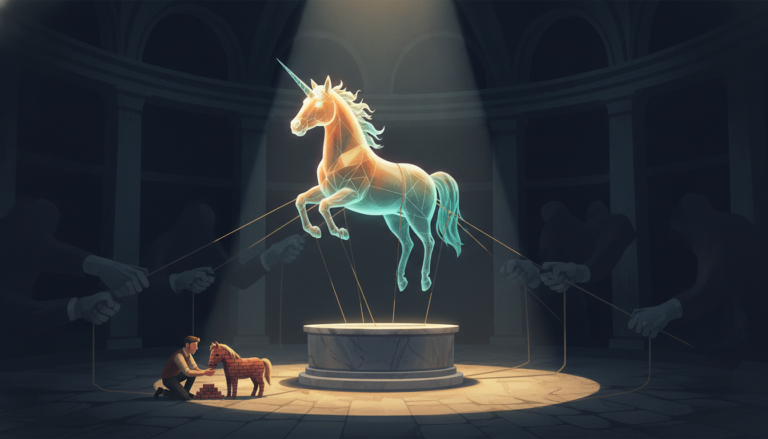
Read those two halves next to each other. The thing founders fear most (AI) is not the thing the data says kills them (no product-market fit). They’re scared of a wave that’s coming while standing in a hole they dug themselves.
The number that tells the real story
Forget the AI stat for a second. The number that actually matters is the one that moved: running out of money fell from 38% to 25% in three years.
Think about why. Building got cheap. Stupidly cheap. You can stand up a working product in a weekend now, for the price of a few API calls and a domain name. The old startup obituary, “great team, great idea, ran out of runway before they figured it out,” is becoming rarer because runway stopped being the binding constraint. Money isn’t what runs out first anymore.
So what runs out first? Patience. Belief. The founder’s willingness to keep going when the thing they built, fast and cheap and beautifully, still doesn’t have anyone on the other side of it pulling. That’s why burnout shows up at 90% in this report and loneliness at 87%. The failure didn’t get less painful. It just changed shape. It used to look like an empty bank account. Now it looks like a working product and an empty inbox.
When money was the wall everyone hit, “we ran out of cash” was a respectable way to die. It sounded like bad luck or bad timing. Now that money is no longer the wall, the only thing left standing between you and survival is the question that was always the real one: does a stranger want this enough to pull it out of your hands and pay for it. AI didn’t create that question. AI just stripped away every excuse that used to let you avoid asking it.
Why founders are scared of the wrong thing
Here’s my honest read, and I could be wrong, but I’ve watched enough of these to bet on it.
“AI is going to disrupt us” is a more comfortable fear than “we don’t have product-market fit.” The first one is external. It’s a weather system. It happens to you. You can be a victim of it and still feel like a serious person. The second one is internal, and it’s embarrassing, because it means the thing you spent a year building is something nobody actually asked for. Of course 50% of founders pointed at the scary external robot. Pointing at the robot hurts less than pointing at the mirror.
But the report is the mirror. 54% of these founders, after the company died, said the lesson was product-market fit. Not “we should have built faster.” Not “we should have used more AI.” We should have understood, earlier, whether anyone wanted the thing. This is the same lesson founders have been learning the hard way since before software existed, and it is genuinely wild to me that we’ve now automated almost every part of building a company except the one part that has always decided who lives.
I’ve written before about how 80% of companies get nothing measurable out of AI, and the real opportunity is hiding inside that failure rate rather than inside the model. Same shape here. The technology is not the moat and it was never going to be the moat, because the moment a tool is available to you it’s available to everyone you’re competing against. AI raised everyone’s building ability to roughly the same level. When everybody can build, building stops being the thing worth points. Demand becomes the only scoreboard.
What to actually do about it
If you take one thing from this report, take this: the threat you can name out loud is rarely the threat that gets you. So go hunting for the quiet one.
Stop measuring yourself on how fast or how cheaply you can build, because that race is over and everyone tied. Start measuring yourself on pull. Did someone who isn’t your friend use it twice. Did a stranger pay. Did anyone get annoyed when it was down. That’s the signal that AI cannot fake for you and cannot manufacture for you, and it’s the only one the failure data actually rewards.
Validate before you build more, not after. The cheapest possible test, a landing page, ten real conversations, one pre-sale to someone who wires you money, beats another month of polishing. If you want a structured way to do it, I laid out the full sequence for pressure-testing a startup idea before you write a line of code, and almost none of it involves the product. It involves the human on the other side.
And pivot earlier than feels comfortable. 81% of these founders pivoted at least once, and 42% wish they’d done it sooner. Nobody, not one, said they pivoted too soon. That asymmetry should tell you everything about which direction your own bias runs. The new bar isn’t “did you build it,” it’s “did you find demand,” which is exactly why revenue inside 90 days is quietly replacing the build-an-MVP-first culture. Money in the door is just product-market fit wearing a receipt.
The part that should make you feel better
Here’s the closing number, and it’s the good one. 81% of founders who lived through failure said they’d start another company. 31% said they’d do it immediately, basically the next morning.
Which means the people who got closest to the real threat, who stood in the hole and felt how cold it was, are the least scared of it. They stopped fearing the robot. They learned the actual lesson, that this whole game was always about whether someone wants what you made, and they want to go play again knowing the rules for real this time.
So fine, be a little worried about AI. But not because it’s going to out-build you. Be worried because it just removed the last place you could hide from the only question that ever mattered. The robot didn’t come to take your company. It came to take your excuses. What you do without them is the whole thing.