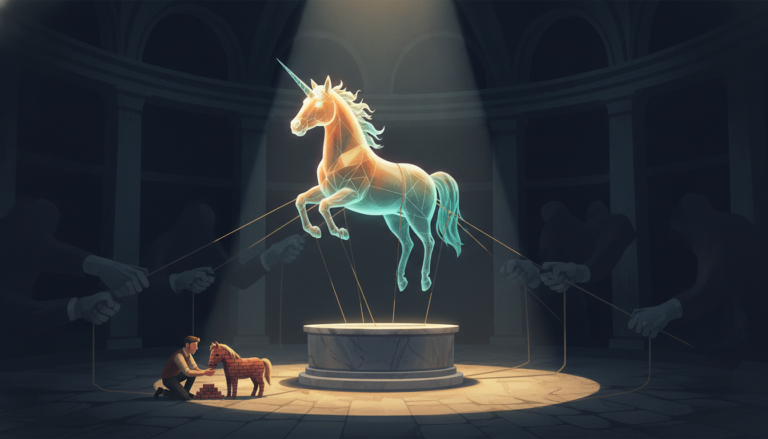

Last Updated on August 17, 2026 by Taya Ziv
Quick answer: In the first quarter of 2026, 47 seed and early-stage companies became unicorns, most of them AI startups with little or no revenue and, in some cases, no shipped product. A billion-dollar valuation that early is not a shortcut past the hard part of building a company. It is the hard part, moved to the front, made bigger, and dressed up as a win. For the tiny number of founders who get that call, it removes their right to be wrong. For everyone else, it quietly rewrites what a “good” round is supposed to look like, and that is the part that will hurt you.
There is a scene in Moneyball where Brad Pitt, playing Billy Beane, keeps telling his scouts that the guy who looks like a big leaguer is not the same as the guy who gets on base. The scouts fall in love with the jaw, the swing, the way a kid looks like a ballplayer. Beane keeps dragging them back to the only question that matters: does he actually produce.
Venture capital just spent six months falling in love with the jaw.
The number that should stop you
Crunchbase closed the books on the first quarter and found something genuinely new: forty-seven seed and early-stage companies crossed a billion-dollar valuation in three months. Not established companies growing into the number. Baby companies, some of them a year old or less, priced like they had already won. That single quarter puts 2026 on track for the largest class of young unicorns anyone has ever counted.
Look at the neighbourhood and the pattern gets sharper. Virtually every one of these early unicorns is an AI company, which makes sense when roughly 80 percent of all venture dollars in the first quarter, about 242 billion of them, went into AI. There is a company that appears to have been founded this year and is already in the club: reporting this spring described a startup called Core Automation reaching a billion-dollar valuation on a hundred-million-dollar seed round a few weeks after launch, then going straight back out to raise at around four billion. Read that again slowly. From one billion to a reported four in a matter of weeks, on a company most people had never heard of a month earlier. An AI research outfit that came out of stealth in May calling itself Recursive Superintelligence, founded in 2025, was valued at 4.65 billion after a single big round. And just ahead of the class of 47 sit the names everyone already knows, like Reflection AI, reported back in March to be in talks to raise 2.5 billion dollars at a 25 billion dollar valuation.
Read those sentences again slowly, because the tech press files them like scores and moves on. A seed round used to be the money you took to find out if the thing worked. It is now, for a handful of teams, the moment they get priced like the answer is already yes.
A billion dollars is not a prize. It’s a price.
Here is the thing nobody hands you with the term sheet. A valuation is not a trophy you put on a shelf. It is a promise you have to keep paying off, forever, in bigger and bigger installments.
When an investor prices your empty company at a billion dollars, they have not decided you are worth a billion dollars. They have decided what you now have to become, and they have set the floor under every conversation you will ever have again. The next round cannot be a billion. It has to be three, or five, or it reads as a stumble. You have not banked safety. You have signed a mortgage on a future you have not built yet, and the market will foreclose the first quarter you miss a payment.
Take the single best example the year has produced. Thinking Machines Lab, the outfit built by former OpenAI CTO Mira Murati, was valued at 12 billion dollars on its very first round. Late last year Reuters reported it was in early talks to raise at a valuation of around 50 billion. That round never landed. By the middle of January its co-founder and chief technology officer Barret Zoph and fellow co-founder Luke Metz had both gone back to OpenAI, with the company still carrying the same 12 billion it started at. Then, in the middle of July, it finally shipped its first broadly available model. Sit with the order of those events. The money showed up first and priced a company that had not shipped anything, the market was asked to price it four times higher, that round never closed, and only after all of that did the actual product arrive. That is the whole argument of this piece in one company. The number is not a trophy. It is a bill, and the market decides when it comes due.
This is the exact mechanism I wrote about when I told founders that a bigger seed round is a bigger promise, not a bigger cushion, and it is quietly ending more companies than it saves. The billion-dollar seed is that same trap with the volume turned all the way up. Worse, it steals the one asset an early company cannot function without, which is the right to be wrong cheaply. A normal seed-stage startup can look at its first six months, realize the idea is soft, and pivot for the price of some pride and a new deck. A company priced at a billion has no such freedom. A pivot is not a pivot anymore. It is a repricing event, and everyone at that table knows it. So the team that most needs to change course is the team least able to afford it. They keep marching toward the number instead of toward the truth.
I have said for years that technology is a distraction until you have proven someone wants what you are selling. The billion-dollar pre-product round is the most expensive way ever invented to skip that proof and hope the market forgives you later.
The market didn’t get smarter. It split in two.
Now, before every founder reading this decides the whole system has lost its mind, let me be fair to the people writing these checks, because they are not idiots and they are not gambling blind. Something real is happening, it is just not what the headline says.
The market did not get dumber. It split into two completely different games that happen to share a vocabulary.
At the very top, a small number of these deals are bets on positioning in an infrastructure layer that is still being poured. When you back Mira Murati, you are not buying revenue. You are buying a near-certainty that a foundational AI company with that team will be somewhere important in five years, and you are paying a stupid price now to avoid paying an insane one later. That is a land-grab bet on scarcity, the same logic that has OpenAI valued at 852 billion dollars while it openly loses money and told the government it does not need to turn a profit. At that altitude, thesis and team genuinely can be the whole asset, because the prize is owning a piece of the ground everyone else will have to build on.
That is one game. Maybe a hundred teams on the planet are playing it. It runs on names, credentials, and a very short list of people who have already proven they can do the impossible.
The other game is the one you are in. It runs on a boring, unglamorous, unkillable question: can you get a stranger with a problem to hand you money for your solution, and can you do it again next month. Nothing about the unicorn headlines changes that question. The physics of your company are exactly what they were the day before Core Automation got priced. You still have to find the person with the pain. You still have to be the thing they choose. The distance between those two games is not a gap you can close by raising more. It is a different sport.
The quieter trap, the one that’s actually coming for you
Here is the part that actually worries me, and it is not the mortgage problem, because almost none of you will ever get the billion-dollar call. It is what these numbers do to your head.
When “a company founded this year is worth a billion dollars” becomes an ordinary Tuesday, it silently resets your sense of normal. Your real round, the honest one you fought for, the one backed by actual customers who actually paid, starts to feel small. Founders come to me a little embarrassed about a genuinely healthy seed, because some 25-year-old they follow announced a number with two more zeros and no product behind it. The comparison is poison, and it is poison precisely because it is invisible. You do not notice your standards moving. You just start feeling like a loser for building a real thing at a real pace.
And that feeling pushes people to do dangerous things. To chase a valuation instead of a customer. To raise more than the business can absorb so the announcement looks respectable. To confuse the size of the round with the strength of the company, which are two entirely separate facts that this market is deliberately blurring. This is the same failure of nerve that makes founders copy the wrong role model. I already argued that when a startup with no product raised half a billion dollars from Jeff Bezos, the correct response was to admire it and then do the exact opposite. The unicorn class of 2026 is that lesson multiplied by 47. Watching the top of the market is fine. Benchmarking yourself against it is how you talk yourself out of the only strategy that was ever going to work for you.
What to actually do about it
So what do you do with all of this, other than feel a complicated mix of envy and dread. A few things, and they are not complicated, which is usually the point.
Measure yourself against your customers, not against a leaderboard. The only valuation that protects you is the one your revenue can eventually justify. Everything above that line is borrowed, and borrowed valuations get called in at the worst possible moment.
If you ever do get handed a number that outruns your company, treat it as a liability with a party attached, not as a victory. Raise into it deliberately, keep your burn boring, and protect your right to change your mind, because that right is the most valuable thing you own at this stage and the big number is trying to sell it out from under you.
And when the comparison creeps in, and it will, go back to the boring question and stay there. Who is this for. Why do they choose you. Can you reach them and get paid. If you can answer those three with real evidence instead of a valuation, you are playing the game that actually pays out, the slow one, the one that was always going to separate the companies that look like winners from the ones that get on base. If you have not answered them yet, no amount of raised money will do it for you, and there is no shame in going and doing the unglamorous work of figuring out whether anyone actually wants the thing before you pour another year into building it.
The unicorns will keep getting minted. Some of them will grow into their price and look like geniuses. A lot of them are going to spend the next two years discovering that a billion-dollar valuation is a promise, and that promises come due. Your job is not to be one of them. Your job is to build something a stranger pays for on purpose. That has never been fundable on thesis and team alone, and thank God for that, because it is the one part of this business that stays honest no matter how loud the room gets.