
Last Updated on July 7, 2026 by Taya Ziv
Every pitch deck I’ve reviewed in the last two years opens with the same slide: “AI is a trillion-dollar market.” Founders throw that number around like confetti. VCs nod along. Nobody questions it because nobody has to back it up with an S-1 filing.
Elon Musk just did. And the number he put on paper makes every pitch deck I’ve ever seen look quaint.
SpaceX filed its S-1 on May 20, targeting a $1.75 trillion valuation and a mid-June listing under the ticker SPCX. The biggest IPO in history. The press is calling it a rocket company going public. The cable news segments show Falcon 9 launches and Starship explosions. Everyone’s talking about Mars.
But if you actually read the filing, the story it tells has almost nothing to do with rockets. Page 11 of the S-1 lays out SpaceX’s total addressable market at $28.5 trillion. Of that, $26.5 trillion comes from AI. That’s 93%. The rocket and satellite business that made SpaceX famous? Seven percent of the future Musk is selling to Wall Street.
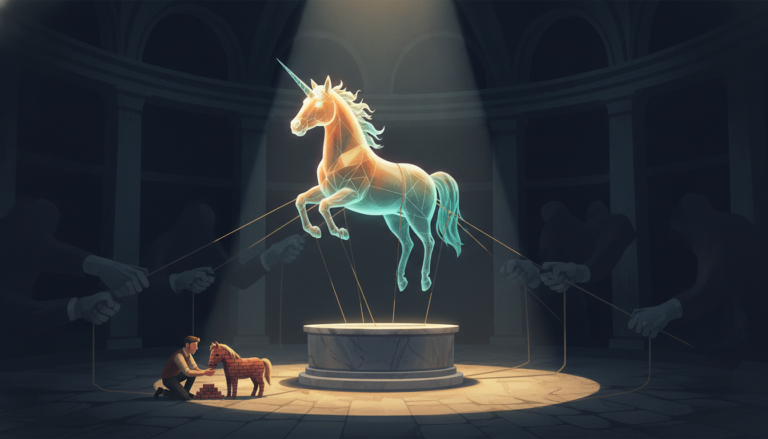
This isn’t a rocket company doing an IPO. This is an AI company that happens to own rockets.
The S-1 nobody’s reading
Here’s what the filing actually reveals when you strip away the Mars poetry.
SpaceX now runs three segments. Space (rockets and NASA contracts), Connectivity (Starlink’s 10.3 million subscribers across 164 countries), and AI (the xAI merger that closed in February 2026 at an $80 billion valuation). Of the three, only Starlink makes money. The satellite business pulled in $11.4 billion in revenue last year with a 30% operating margin. The rocket side is losing money. And the AI side lost $6.4 billion in 2025 on $3.2 billion in revenue, with losses accelerating in Q1 2026 to $2.5 billion on just $818 million.
The AI segment consumed $12.7 billion in capital expenditure last year. In Q1 alone, that number hit $7.7 billion, an annualized pace above $30 billion. That’s more than three times what the rocket division spent on R&D. SpaceX is pouring money into Colossus 1 and Colossus 2 in Memphis (2 million square feet, 220,000 Nvidia GPUs) and breaking ground on a $20 billion hyperscale data center in Mississippi.
And then there’s the deal we already covered: Anthropic paying SpaceX $1.25 billion per month to rent compute at Colossus, locked in through May 2029. That’s roughly $15 billion a year from a single customer. Plus the $60 billion option to acquire Cursor, the AI coding tool that went from developer darling to SpaceX’s most expensive accessory. If the deal falls through, Cursor still walks away with $10 billion in cash and services.
The S-1 is 400 pages long. The word “Mars” appears a lot. But the capital allocation tells a different story. Follow the money, and this is an AI infrastructure company that launches satellites as a side hustle.
The math that should worry every founder
Here’s the part that matters if you’re building something.
SpaceX expects to raise roughly $80 billion from the IPO. Sounds like a war chest. But the S-1 reveals that $62.8 billion, 78% of those proceeds, is already spoken for. One-third goes to Valor Equity Partners, an early investor cashing out. One-third goes to repay debts from X Corp and xAI. One-third goes to Echostar for a spectrum acquisition. That leaves less than $18 billion for actual growth investment. The AI segment alone burned more than that in the past five quarters.
So where does the money come from? The prospectus mentions issuing more shares and taking on debt. In other words, dilution and interest payments. The profitable satellite business generates roughly $1 billion in free cash flow that could support AI, but that’s pocket change against a $30 billion annual capex run rate.
David Trainer at New Constructs ran the math. To deliver decent returns at a $1.5 trillion valuation, SpaceX would need to book $189 billion in annual profits by 2035. No American company has ever hit that number. SpaceX is currently losing money.
I’m not saying it can’t work. Musk has a track record of making impossible things happen. But the S-1 itself warns investors on page 53 that they should “expect a multi-year investment horizon before these deployments translate into sustained positive AI Segment Adjusted EBITDA.” That’s corporate-speak for “this is going to burn cash for a long time before it makes money.”
Why SpaceX joining the AI fight changes the map
The more interesting signal for startup founders isn’t the valuation or the losses. It’s who SpaceX is choosing to compete with.
By merging with xAI and going all-in on AI infrastructure, SpaceX is entering the hyperscaler arena. Microsoft, Google, Amazon, CoreWeave. These are the companies that control the compute layer everything else runs on. We’ve talked about the $725 billion capex race between these giants, and how the cost of AI infrastructure has become the defining constraint of the industry. SpaceX just joined that race with a Colossus-sized checkbook.
And SpaceX brings something the hyperscalers don’t have: the ability to build its own physical infrastructure from scratch. The Colossus 1 data center was built in 120 days. The S-1 talks about orbital AI compute capacity of 100 gigawatts by the end of the decade, using Starship to put data centers in space. That sounds like science fiction until you remember that Starlink went from concept to 10 million paying subscribers in less than five years.
For founders, this creates a weird new reality. The compute layer you depend on is being consolidated into fewer and bigger hands. Every major AI company, whether it’s Anthropic, OpenAI, or the 130 agent startups fighting for survival, runs on infrastructure controlled by five or six players. SpaceX becoming number six (or five, or four) means more competition at the infrastructure layer, which could mean cheaper compute eventually. But it also means more dependency. And when your infrastructure provider is also acquiring your tools (remember, Cursor at $60 billion is now essentially a SpaceX subsidiary), the vertical integration starts looking less like competition and more like consolidation.
The Starlink problem nobody’s discussing
Here’s what I keep thinking about. Starlink is the only part of SpaceX that actually works as a business right now. But it’s showing early signs of the same problem every subscription company eventually faces: the customers are getting cheaper.
Revenue per subscriber dropped from $99 in 2023 to $66 in Q1 2026. Subscriber growth is still strong (doubled to 10.3 million last year), but the new customers are paying less. Pricing competition from terrestrial networks, T-Mobile, Google Fiber, local ISPs, is squeezing margins. Starlink is real and profitable, but it’s not growing fast enough to fund the AI moonshot on its own.
That means the AI bet has to work. Not eventually. Relatively soon. Because the alternative is an ever-expanding capital requirement funded by share dilution and debt, which is exactly how companies with great technology and bad unit economics end up disappointing their investors.
What the S-1 is really telling you
Every S-1 filing is a story. The company tells investors what it wants them to believe. SpaceX wants you to believe it’s the next platform company, a vertically integrated colossus that controls launch, connectivity, and compute. Rockets get your payload to orbit. Satellites deliver your internet. Data centers train your AI. It’s Amazon Web Services meets Starlink meets NASA, all owned by the richest person on earth.
It’s a compelling story. It might even be true.
But the S-1 also tells you the uncomfortable parts if you know where to look. The AI segment losing $6.4 billion a year. The IPO proceeds already mostly allocated. The multi-year timeline before AI turns profitable. The governance structure where Musk holds 42% of equity and 85% of voting power, meaning public shareholders have essentially zero control.
If you’re a founder, the takeaway isn’t whether to buy SpaceX stock. It’s what this filing tells you about where the industry is heading. The compute layer is being consolidated by companies willing to lose billions per year to control it. The AI infrastructure wars have a new entrant with deeper pockets and a higher risk tolerance than anyone except maybe the sovereign wealth funds. And the line between “launch provider” and “AI company” and “developer tools company” is being erased by vertical integration.
The biggest IPO in history just told you what business the future is in. It’s not the one with the rockets on the logo.